About the Journal
Mission Statement
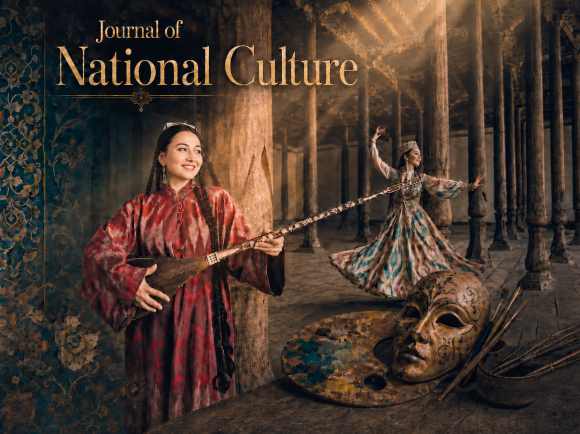
The journal "Milliy Madaniyat", "Журнал национальной культуры", "Journal of National Culture" is a specialized publication focused on the spheres of music culture and art. Its main goal is to comprehensively highlight scientific, practical, and innovative developments in the field of culture, to better meet readers' needs for scientific-methodological and innovative information, and to ensure broad and effective use of the journal’s capabilities.
Goals of the Journal:
-
To promote scholarly research in the field of musical culture and arts of Uzbekistan and the world.
-
To create a platform for dialogue among scholars, practitioners, educators, and artists.
-
To document and popularize cultural heritage.
-
To develop an interdisciplinary approach to the study of music and the arts.
-
To increase access to scientific and methodological resources for researchers, students, and educators.
-
To expand international academic cooperation through publications in English, Uzbek, and Russian.
-
To foster academic mobility and the exchange of research outcomes between institutions.
-
To archive and preserve academic works in the field of culture for future generations.
The founder of the journal is the Institute of Uzbek Musical Art named after Yunus Rajabiy. The journal was established in 2025. Articles are published in English, Uzbek, and Russian. Until 2026, the journal was published six times a year. Since 2026, the journal has shifted to a quarterly publication format in order to optimize the editorial, peer-review, and publishing workload.
.
License number: С-5669811. E-ISSN: 3060-5490
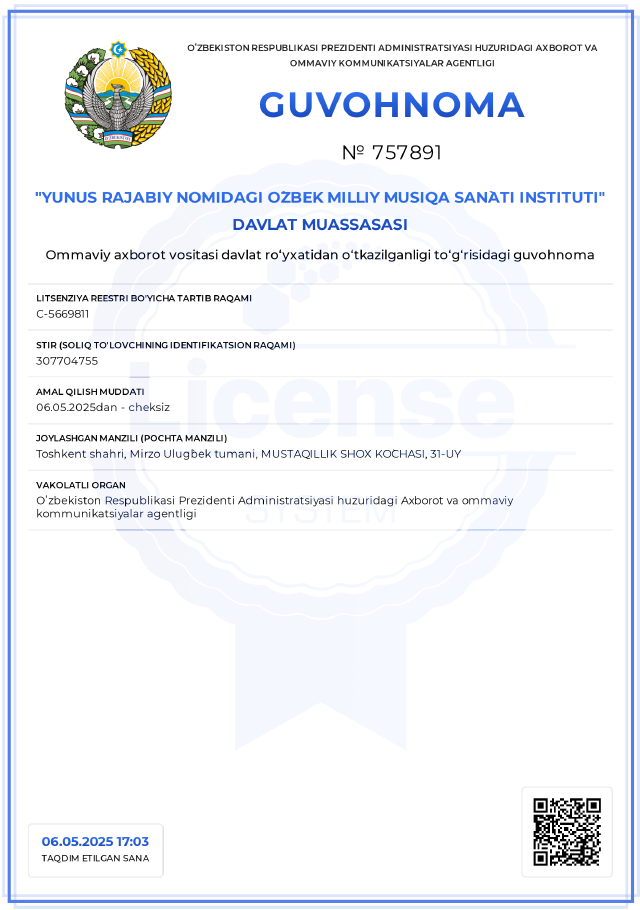
Editorial office address: 100000, Tashkent, Mirzo-Ulugbek district, Mustaqillik Avenue 31.
Indexing
- Supreme Attestation Comission at Cabinet of Ministers of the Republic of Uzbekistan
- Google Scholar
- Crossref
Aims and Scope
The journal publishes research on the arts of Uzbekistan, Central Asia and other regions of the world. Manuscripts are accepted in all fields of art studies listed by the Higher Attestation Commission (OAK) of the Republic of Uzbekistan under code 17.00.00 – Art Studies:
- 17.00.01 – Theatre arts: theatre history and theory, drama, directing, acting, stage design, choreography and dance.
- 17.00.02 – Musical arts: musicology, history and theory of music, contemporary music and composition, maqom and traditional music, ethnomusicology and musical folklore, performance studies, music education.
- 17.00.03 – Film art. Television: film studies, cinema history, television, animation and other screen arts.
- 17.00.04 – Fine and decorative arts: painting, graphics, sculpture, miniature and calligraphy, decorative and applied arts, crafts.
- 17.00.05 – Theory and history of design: graphic, industrial, costume and environmental design.
- 17.00.06 – Museology. Conservation, restoration and preservation of historical and cultural heritage.
- 17.00.07 – Theory and history of culture. Cultural studies.
- 17.00.08 – Theory and history of art: general art history, aesthetics, art criticism, interdisciplinary research in the arts.
When submitting, authors indicate the OAK code that their article corresponds to.
Journal Content
All papers for publication are selected on the basis of their quality and contribution to existing knowledge. To make submission, your document must be one of the following types and demonstrate chief results of research in the field:
GRNTI (Code of State Categories Scientific and Technical Information)
Art. Art History / Music. Musicology
Art. Art History / Theatre. Theatre studies
Art. Art History / Dance. Choreography
Art. Art History / Stage
OECD Fields of Science: 604. Art.
Please note, that to make submission, your document must be one of the following types:
- Article. Most often subdivided into sections: abstract, introduction, materials & methods, results, conclusions, discussion and references. However, case reports, technical and research notes and short communications are also considered to be articles, and may be as short as one page in length.
- Review article. Significant review of original research, also includes conference papers.
Reviews typically have an extensive bibliography. Educational items that review specific issues within the literature are also considered to be reviews. As non-original articles, reviews lack the most typical sections of original articles, such as materials & methods and results. - Conference paper. Original article reporting data presented at a conference or symposium. Conference papers are of any length, reporting data from a conference, with the exception of conference abstracts. Conference papers may range in length and content from full papers and published conference summaries to short items as short as one page in length
- Data paper. Searchable metadata documents describing an online accessible dataset, or group of datasets. The intent of a data paper is to offer descriptive information on the related dataset(s) focusing on data collection, distinguishing features, access, and potential reuse rather than information on data processing and analysis.
- Short survey. Short or mini-review of original research. Short surveys are similar to reviews, but usually are shorter (not more than a few pages) and with a less extensive bibliography.
Documents should be submitted according to the Author Guidelines for online manuscript submission. To submit a document, click here.
The JNC provides immediate open access to its content on the basis of the free open access principles.
The Journal joined the Budapest Open Access Initiative (BOAI).
This is an open access journal, which means that all content is freely available without charge to the user or his/her institution. Users are allowed to read, download, copy, distribute, print, search, or link to the full texts of the articles, or use them for any other lawful purpose, without asking prior permission from the publisher or the author. This is in accordance with the BOAI definition of open access.
Readers and authors can acquaint with the electronic version of the journal issues free in the "Archives" (materials are available for download free of charge). PDF versions of scholarly articles are in open access under the Attribution Non-Commercial No Derivatives CC BY-NC-ND licence.
The JNC is full free access (Libre Open Access) which mean there is no any fee for access to articles.
If, for any reason, the activities of the Editorial office or the website are suspended, you can find the archives of the journal issues in uzmmsi.uz.
Updated 11.04.2026